Complete guide to shipping container types and sizes

Shipping containers are essential for transporting freight across the globe, carrying everything from boxes and pallets to oversized machinery and temperature-sensitive cargo. Since containers vary in dimensions, features, and suitability, it’s important to understand these differences when planning your shipment.
Choosing the right shipping container can save time, reduce costs, and ensure your cargo arrives safely. Whether it’s a standard dry container, a high cube for extra space, or a refrigerated shipping container for perishables, using the right type of container makes all the difference.
In this guide, we’ll walk you through the most common types of containers, their sizes, and what makes each one suitable for different cargo. By the end, you’ll have a clear understanding of how to pick the best shipping container for your next shipment.
What are shipping containers?
At their core, shipping containers are steel boxes designed to move cargo efficiently from one place to another. Their real power lies in standardization: the same container can travel seamlessly by ship, train, and truck without the cargo inside ever being unpacked.
This uniform design is what makes modern global trade possible. Containers can be stacked on massive cargo vessels, transferred quickly at ports, and loaded onto rail or road transport with minimal handling. Whether the cargo is consumer goods, raw materials, or industrial equipment, containers create a secure and predictable way to move it across long distances.
Over time, containers have evolved far beyond a single “one-size-fits-all” solution. Today, there are containers built specifically for oversized machinery, temperature-sensitive goods, liquids, heavy bulk materials, and more. Understanding these differences is key to choosing the right container for your cargo.
Now let’s move into the most common container types – starting with the standard dry container, the workhorse of global shipping.
Standard dry container

Standard containers (also known as dry containers or dry vans) are the backbone of global container shipping. They’re the most common type of freight containers and are designed to transport everyday goods that don’t require temperature control or special handling.
Sizes
- 20-foot (TEU) container: A global standard, often used for heavier cargo or smaller shipments. Standard sizes define typical shipping container dimensions, with a 20-foot container measuring 20' × 8' × 8'6".
- 40-foot (FEU) container: The most common choice for international freight, offering twice the capacity of a 20ft container. Standard 40-foot containers measure 40' x 8' x 8'6".
- 45-foot container: A longer, regional variant used on specific intermodal routes. The most common 45-foot container size is 45' x 8' x 9'6" (high cube).
Main purpose
General-purpose containers are used to carry dry, non-perishable cargo, such as:
- Boxes and cartons
- Palletized goods
- Consumer products and equipment
They are fully enclosed, weather-resistant, and suitable for long-distance transport. Constructed with durable materials, they often feature wood flooring for cargo safety and structural support.
Pros
- Cost-effective and easy to source worldwide
- Stackable and compatible with sea, rail, and road transport
- Secure design with lockable doors and durable flooring for pallets
Cons
- Not suitable for temperature-sensitive cargo
- Limited flexibility for oversized or very tall goods
Tips
- Always verify interior dimensions, door opening size, and maximum payload before loading.
- Distribute weight evenly to protect the container structure and comply with transport regulations.
- Best suited for general cargo, boxes, pallets, and equipment that can be easily loaded through standard container doors.
- Knowing the tare weight of the container is important for accurate freight calculations and compliance with transport regulations.

High cube container
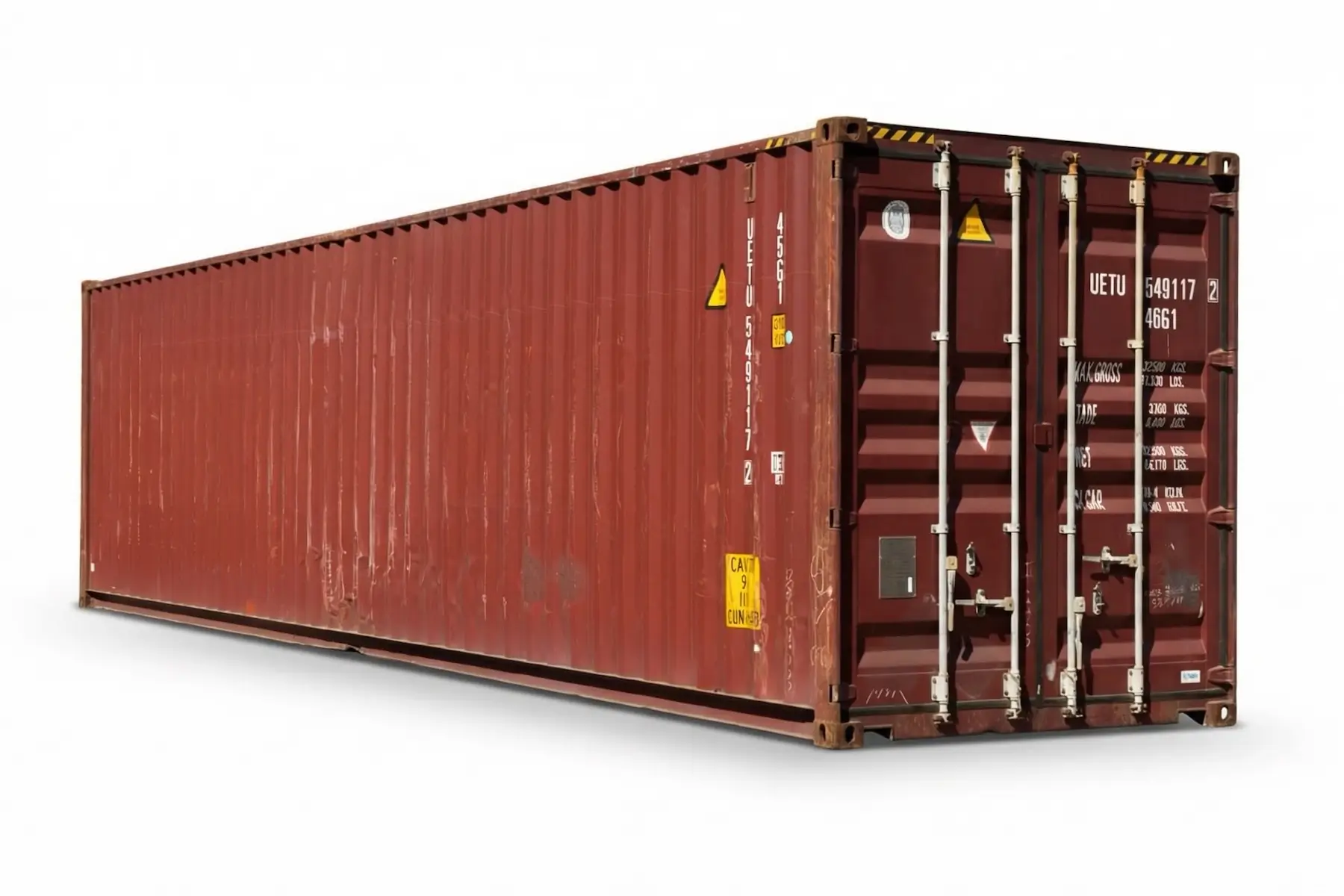
High cube containers are standard dry containers with extra height, designed for taller and more voluminous cargo. While they look similar from the outside, the added vertical space provides significantly more usable capacity.
They are widely used when shippers need more capacity without increasing the container’s footprint.
Sizes
- 40-foot high cube: The most common high cube container, offering additional internal height compared to standard 40ft containers.
- 45-foot high cube: A longer variant, commonly used on specific intermodal routes and for high-volume shipments.
High cube containers are 9′6″ (2.89 m) high, while standard containers reach 8′6″ (2.59 m).
Main purpose
High cube containers are designed to carry lightweight but voluminous cargo, such as:
- Furniture and furnishings
- Palletized consumer goods
- Large cartons and packaging materials
They are fully enclosed and weather-resistant, making them suitable for long-distance transport while maximizing available cargo space.
Pros
- Approx. 12–15% more interior dimensions than standard containers
- Compatible with standard handling equipment and intermodal transport
- Allow shippers to carry more cargo in a single container, improving efficiency for voluminous shipments
Cons
- Slightly higher cost than standard containers
- Weight limits are similar to standard containers, despite the added volume
Tips
- Always check internal height and door clearance when loading tall cargo.
- High cube containers are best used when volume, not weight, is the main constraint.
- Ensure loading plans account for proper weight distribution to maintain stability during transport.
Refrigerated container
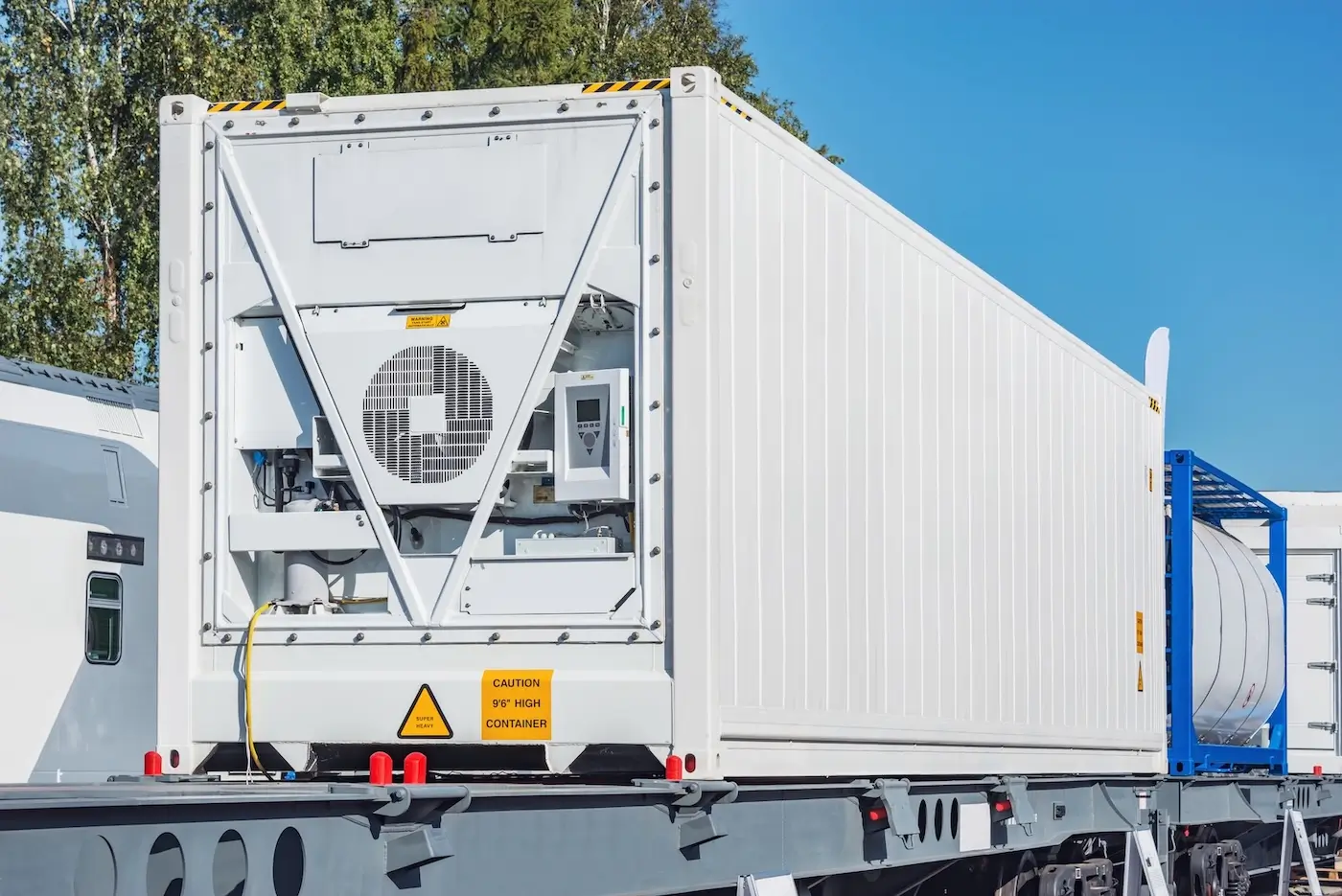
Refrigerated containers (often called reefers) are specially designed containers equipped with built-in cooling systems to keep cargo at controlled temperatures throughout the journey. They look similar to standard dry containers, but their insulated walls and refrigeration units allow sensitive goods to travel safely over long distances.
They are widely used in international shipping for cargo that must remain within a specific temperature range from origin to destination.
Sizes
- 20-foot refrigerated container: Ideal for smaller temperature-sensitive shipments or dense cargo with limited volume.
- 40-foot refrigerated container: The most common reefer size, used for larger volumes of perishable goods.
- 40-foot high cube refrigerated container: A taller variant offering additional internal space for voluminous refrigerated cargo.
Refrigerated containers are typically designed to maintain temperatures ranging from approximately -30°C to +30°C, depending on cargo requirements.
Main purpose
Refrigerated containers are designed to carry temperature-sensitive cargo, such as:
- Fresh and frozen food
- Fruits and vegetables
- Pharmaceuticals and medical supplies
- Flowers and other perishables
They maintain consistent temperature, airflow, and humidity to protect cargo quality during long-distance transport.
Pros
- Precise temperature control throughout the shipment
- Suitable for a wide range of perishable and sensitive goods
- Remote temperature monitoring options for improved cargo safety
Cons
- Higher transport and rental costs than standard containers
- Require a continuous power source during transport and storage
Tips
- Pre-cool the container before loading to prevent temperature shocks.
- Always verify temperature settings based on cargo requirements.
- Ensure proper airflow around pallets and avoid blocking ventilation channels inside the container.
Open top container
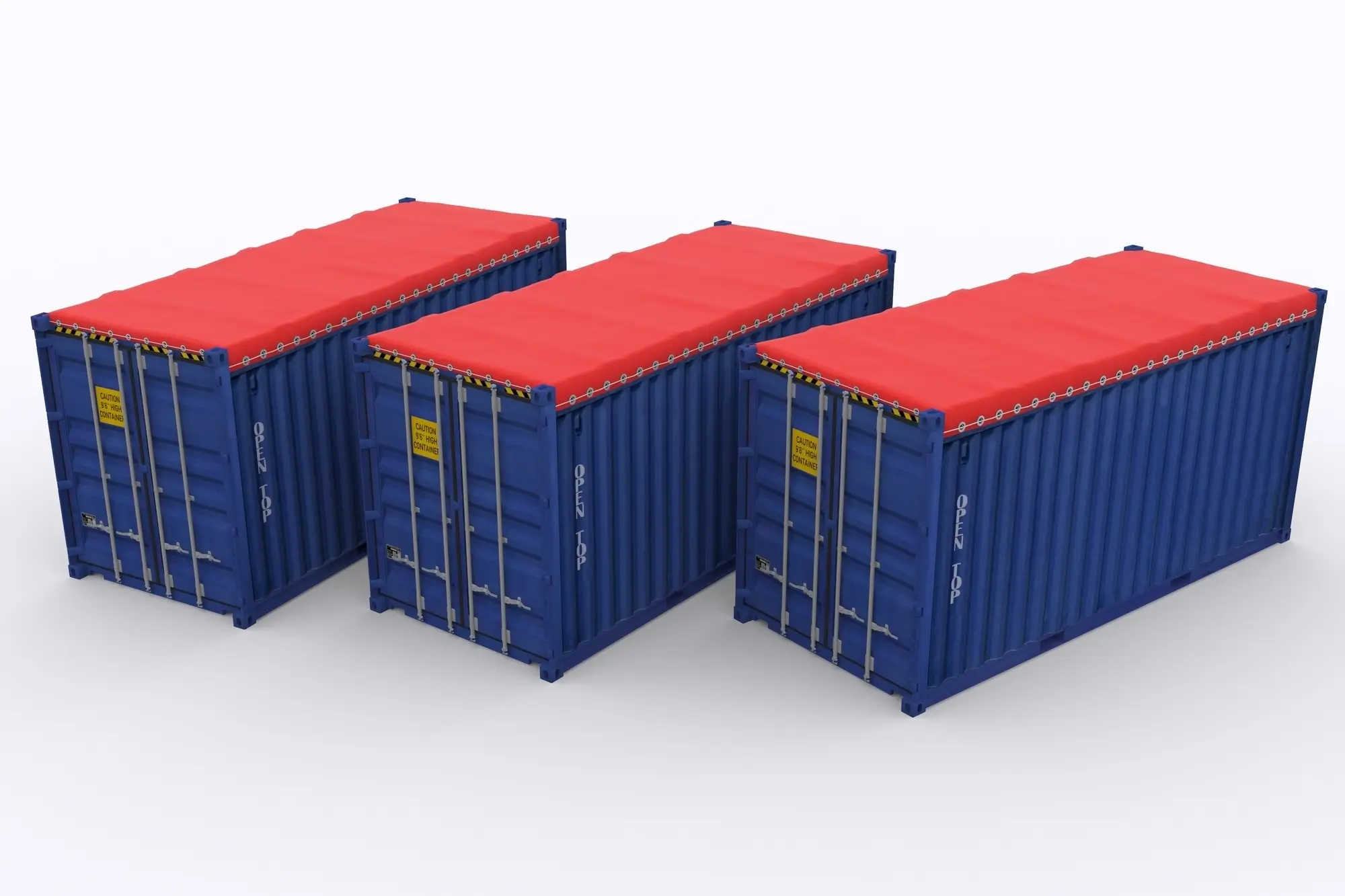
Open top containers are designed for cargo that cannot be easily loaded through standard container doors. Instead of a fixed steel roof, they feature a removable tarpaulin or hard roof, allowing cargo to be lifted in from above using cranes or other heavy handling equipment.
They are commonly used in international shipping for oversized, tall, or awkwardly shaped cargo that requires top loading.
Sizes
- 20-foot open top container: Suitable for smaller oversized or heavy items that exceed standard door height.
- 40-foot open top container: Used for longer or taller cargo that cannot fit inside standard dry containers.
Open top containers have the same standard external dimensions as regular containers but provide open-top access for vertical loading.
Main purpose
Open top containers are designed to carry oversized or tall cargo, such as:
- Heavy machinery and industrial equipment
- Timber, steel products, and pipes
- Scrap metal and bulk materials
They allow vertical loading and are secured with a removable roof covering once cargo is in place. Lashing devices are often attached to the container's top and bottom longitudinal rails to keep cargo stable during transport.
Pros
- Enables top loading of tall or irregularly shaped cargo
- Flexible loading options for heavy and bulky items
- Compatible with standard intermodal transport
Cons
- Less weather-resistant than fully enclosed dry containers
- Cargo may require additional securing and protection
Tips
- Always ensure cargo is properly secured before closing the roof covering.
- Check crane access and lifting points when planning top-loaded shipments.
- Use protective coverings for weather-sensitive cargo.
Flat rack container

Flat rack containers are designed for special cargo that is too wide, too tall, or too heavy to fit inside standard enclosed containers. Instead of solid side walls, they feature collapsible or fixed end walls and an open platform, making them ideal for transporting oversized and heavy loads.
They are widely used in international shipping for project cargo and industrial shipments that require special handling.
Sizes
- 20-foot flat rack container: Commonly used for heavy and compact machinery or equipment.
- 40-foot flat rack container: Suitable for long, wide, or high-volume oversized cargo.
Flat rack containers have standard external lengths but provide open sides and top access for easy loading.
Main purpose
Flat rack containers are designed to carry oversized and heavy cargo, such as:
- Heavy machinery and industrial equipment
- Vehicles and construction equipment
- Pipes, steel structures, and large crates
They allow side and top loading and are secured using various lashing devices to keep cargo stable during transport.
Pros
- Ideal for oversized, wide, and heavy cargo
- Allows flexible loading from the top and sides
- Strong structure designed to handle heavy loads
Cons
- Limited protection from weather and external elements
- Requires careful planning and proper lashing
Tips
- Use certified lashing devices to secure cargo firmly to the container frame.
- Verify weight limits and load distribution before shipping.
- Consider protective coverings for weather-sensitive cargo.
Tank container (ISO tank)
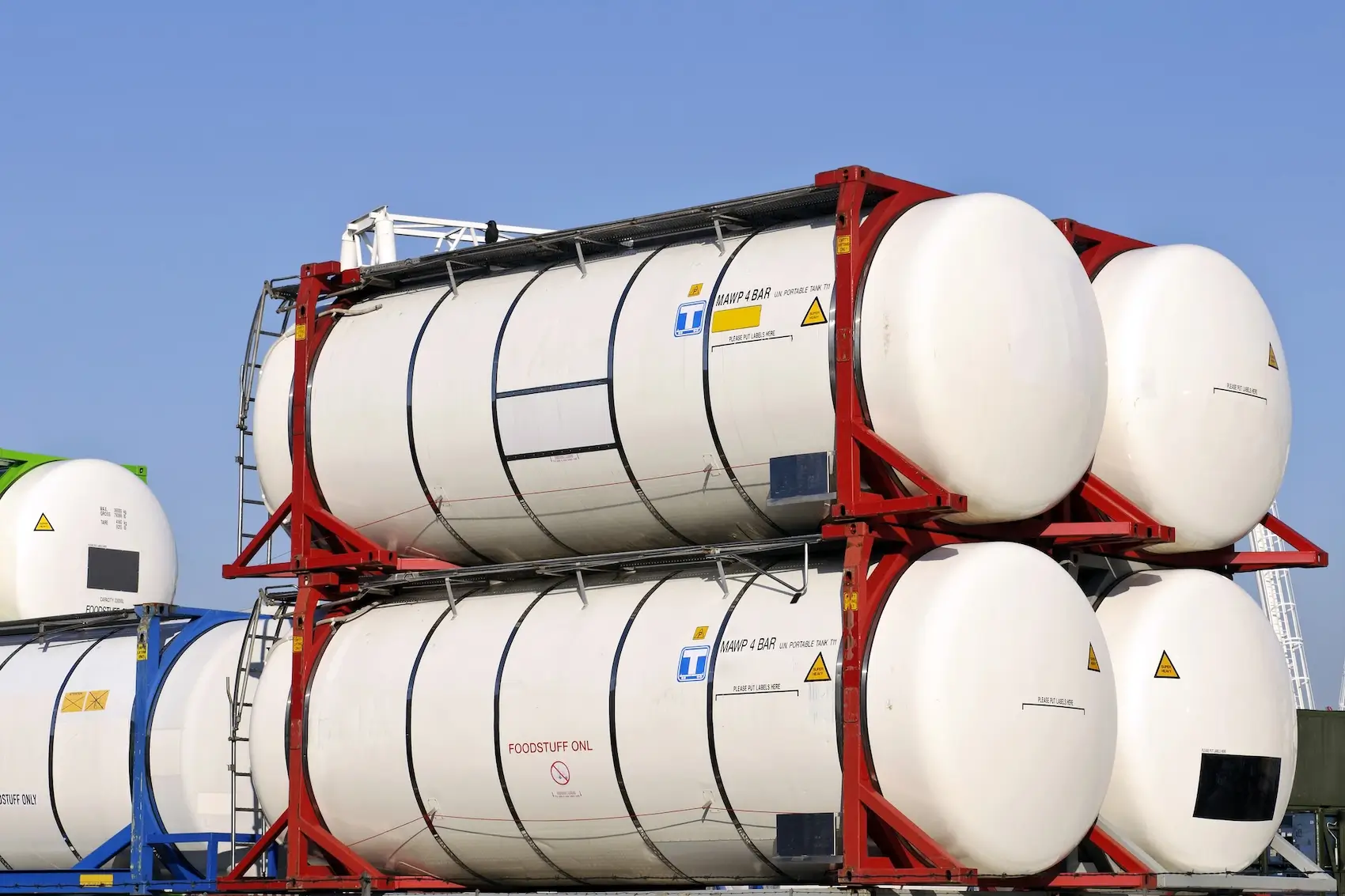
Tank containers (or tanktainers) are specially designed for transporting liquids, gases, and certain powdered products in bulk. They consist of a cylindrical tank mounted within a steel frame, providing a safe and standardized way to ship liquid cargo across sea, rail, and road networks.
They are widely used in international shipping for bulk liquid transport that requires strict safety and handling standards.
Sizes
Standard ISO tank containers are built within the same external dimensions as a 20-foot dry container (approx. 6.06 m × 2.44 m × 2.59 m), allowing them to be handled, stacked, and transported worldwide using standard intermodal equipment.
Non-ISO tank units, such as European swap body tanks, may exceed these dimensions and are designed for regional road and rail transport rather than global sea container stacking.
- 20-foot tank container (standard ISO tank): The most widely used tank type. Typical capacity ranges between 21,000 and 26,000 litres, depending on tank design, wall thickness, and safety requirements. Used for both hazardous and non-hazardous liquids across global shipping routes.
- Swap body tank containers (European intermodal): Longer and slightly wider tank units designed mainly for road and rail transport in Europe. These offer larger capacities, typically 30,000 to 36,000 litres, but are not suitable for standard sea container stacking.
- Gas tank containers: Reinforced ISO tanks designed for pressurized gases, often with lower capacities (around 17,000–25,000 litres) due to thicker tank walls and safety layers.
Main purpose
Tank containers are designed to carry liquid and semi-liquid cargo, such as:
- Chemicals and industrial liquids
- Food-grade liquids (oils, juices, wine)
- Fuels and lubricants
- Liquid raw materials
They ensure safe containment, controlled discharge, and protection from contamination.
Pros
- High safety standards for hazardous and non-hazardous liquids
- Reusable and more environmentally friendly than drums or barrels
- Reduced handling and faster loading/unloading
- Stackable as ISO units for long distances
Cons
- Higher rental and transport costs compared to dry containers
- Require specialized cleaning between different cargo types
Tips
- Always verify cargo compatibility and tank material before loading.
- Ensure valves and seals are properly secured before transport.
- Use certified operators for filling and discharge procedures.
Open side container
.webp)
Open side containers are designed for cargo that needs wider and more flexible access than standard end-door containers can provide. In addition to regular end doors, they feature full-length side doors that open along one side of the container, allowing easier loading and unloading of long, wide, or awkwardly shaped cargo.
They are commonly used in international shipping when cargo cannot be efficiently handled through standard container doors.
Sizes
- 20-foot open side container: Suitable for smaller shipments that require side access for easier loading.
- 20-foot high cube open side container: A taller side-opening variant (9′6″) used for compact but tall industrial cargo.
- 40-foot open side container: The most common size, ideal for long or wide cargo that needs full-length access.
- 40-foot high cube open side container: A taller side-opening variant with 9′6″ height, offering extra vertical clearance for bulky or tall cargo that cannot fit inside standard open side containers.
Main purpose
Open side containers are designed to carry cargo such as:
- Long machinery and industrial equipment
- Palletized goods requiring side access
- Oversized cartons and bundled materials
They allow loading along the entire length of the container, reducing handling time and simplifying positioning.
Pros
- Full-length side doors allow fast and flexible loading
- Easier access to cargo compared to standard end-door containers
- Compatible with standard intermodal transport
Cons
- Slightly reduced internal width due to door frame structure
- Typically more expensive than standard dry containers
- Slightly reduced torsional rigidity compared to fully enclosed containers
Tips
- Check side-door opening width and height before planning loads.
- Ensure cargo is properly secured to prevent shifting when doors are opened.
- Ideal for long or wide items that are difficult to position through standard container doors.
Ventilated container
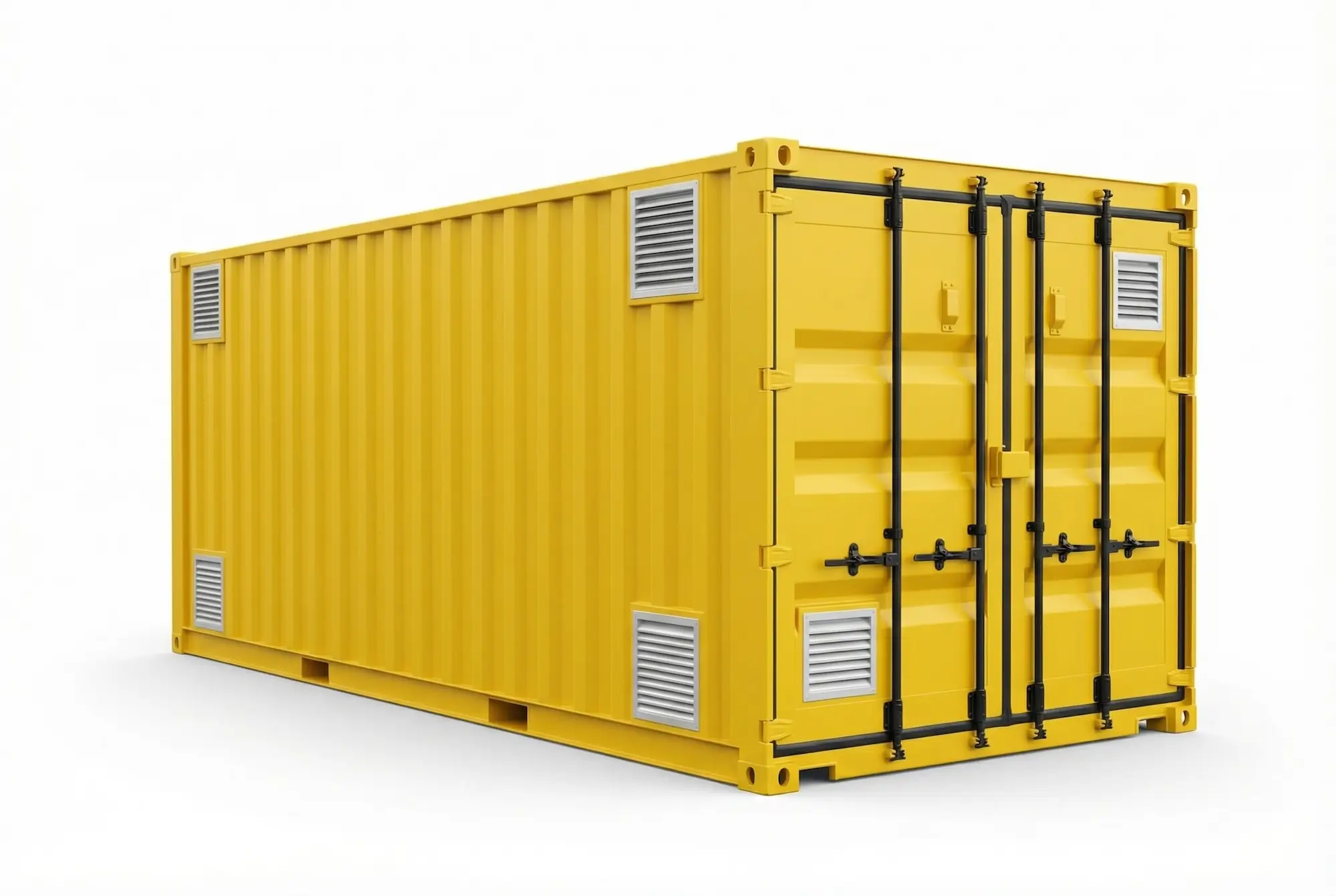
Ventilated containers are designed for cargo that requires passive ventilation but not temperature control. They feature built-in ventilation openings that allow natural air circulation, helping prevent moisture buildup, condensation, and mold during long-distance transport.
They are commonly used in international shipping for moisture-sensitive goods that need to “breathe” while remaining protected from the elements.
Sizes
- 20-foot ventilated container: The most common size, ideal for dense and moisture-sensitive cargo.
- 40-foot ventilated container: Used for larger volumes of cargo requiring passive airflow.
Ventilated containers follow standard ISO dimensions and are handled like regular dry containers.
Main purpose
Ventilated containers are designed to carry cargo such as:
- Coffee beans and cocoa
- Agricultural products
- Textiles and leather goods
- Other moisture-sensitive materials
They reduce condensation and help preserve cargo quality over long distances.
Pros
- Improved airflow reduces moisture and mold risk
- No power supply required
- Suitable for long-distance transport
Cons
- Not suitable for temperature-controlled cargo
- Limited availability compared to standard dry containers
Tips
- Ensure ventilation openings are not blocked during loading.
- Use moisture-absorbing materials for sensitive goods.
- Best used for dry cargo that requires airflow but not refrigeration.
Insulated / Thermal container

Insulated (thermal) containers are designed to slow down temperature change, not actively control it. Unlike refrigerated containers, they have no cooling machinery. Instead, they rely on thick insulation and a sealed interior to protect cargo from heat, cold, and sudden climate fluctuations during transit.
They are widely used for short to medium-distance routes where temperature stability is critical, but full refrigeration is unnecessary.
Sizes
- 20-foot insulated container: The most common thermal container size. Internal capacity is reduced due to thick insulation panels.
- 40-foot insulated container: Used for larger temperature-sensitive shipments that do not require powered cooling. Typically offers 5–15% less internal volume than a standard dry 40ft container.
Some thermal containers are also supplied as “non-operating reefer” (NOR) containers – repurposed refrigerated units with the cooling machinery disabled.
Main purpose
Insulated containers are designed to carry cargo such as:
- Pharmaceuticals and vaccines
- Chocolate, cosmetics, and food ingredients
- Temperature-sensitive chemicals
They protect cargo from heat and cold shock during loading, waiting periods, and transit.
Pros
- Better temperature stability than dry containers
- Lower operating cost than refrigerated containers
- No power supply required
Cons
- Reduced interior dimensions compared to dry containers
- No active temperature control
- Less suitable for long routes with extreme climates
Tips
- Use data loggers to monitor temperature stability.
- Combine with thermal liners or gel packs for better protection.
- Ideal for routes where reefer containers would be unnecessarily complex or costly.
Half-height container
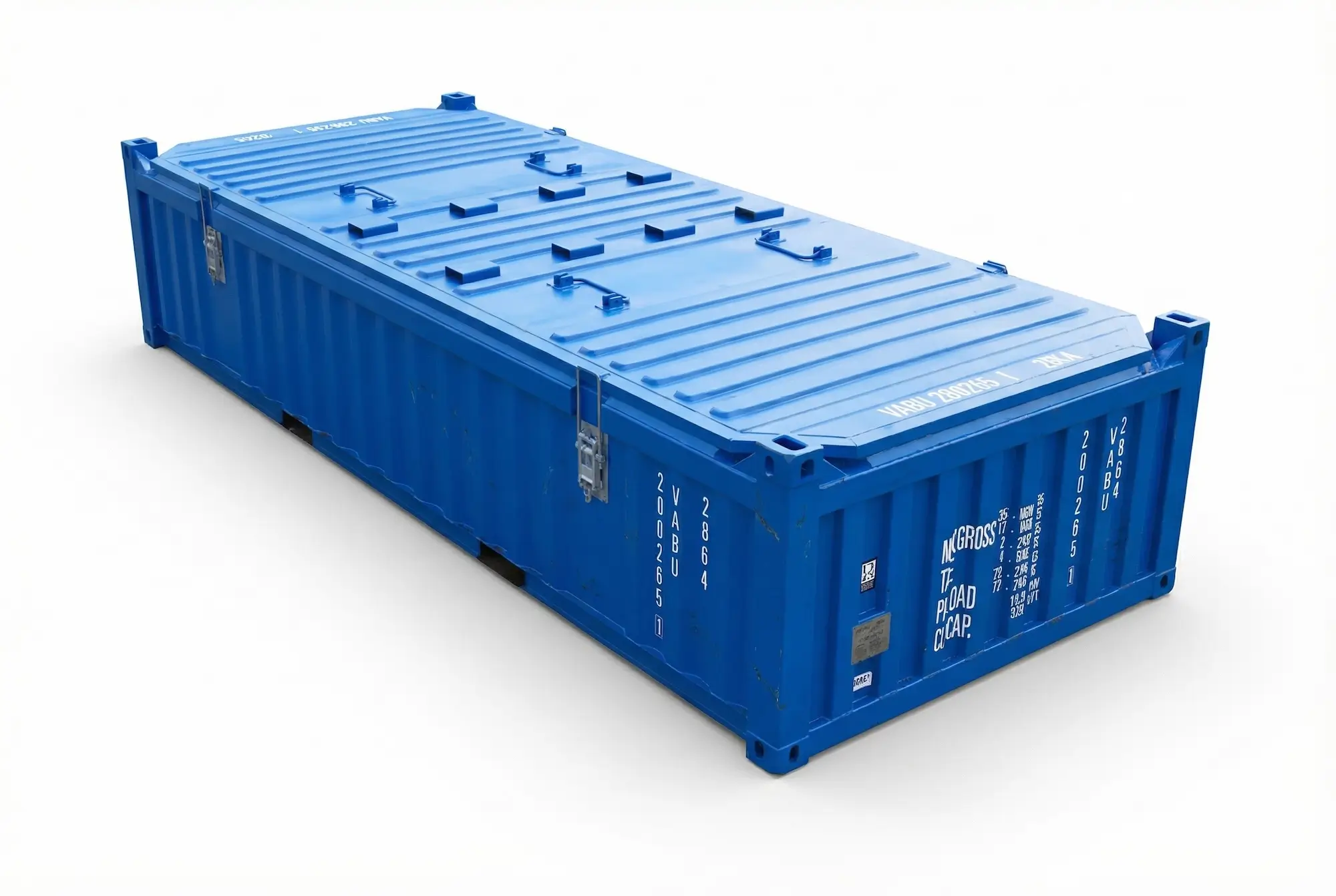
Half-height containers are designed for extremely heavy and dense cargo that would exceed weight limits if loaded into full-height containers. As the name suggests, they are approximately half the height of standard containers, making them ideal for low-center-of-gravity loading and crane handling.
They are most commonly used in mining, metal, and construction supply chains.
Sizes
- 20-foot half-height container: The standard and most widely used format. Designed for very dense cargo with maximum payload efficiency, it has a typical internal height of around 4′3″–4′6″ (1.3–1.4 m), allowing extremely heavy materials to be loaded without exceeding axle or stack weight limits.
- 40-foot half-height container: A less common variant, used for longer shipments of heavy bulk cargo. It shares the same reduced internal height as the 20-foot version but provides additional length for larger or project-based loads.
Half-height containers are built on reinforced ISO frames and are compatible with standard container handling equipment.
Main purpose
Half-height containers are designed to carry ultra-dense cargo such as:
- Ores and minerals
- Scrap metal
- Coal and stone
- Aggregates and metal ingots
They are optimized for tipping, grabbing, and crane discharge.
Pros
- Extremely high payload capacity
- Lower center of gravity improves stability
- Ideal for bulk loading and discharge operations
Cons
- Very limited internal volume
- Not suitable for general cargo or palletized goods
Tips
- Best used for crane or grab loading operations.
- Always verify terminal compatibility for tipping and discharge.
- Ensure correct liner or coating is used when shipping corrosive minerals.
Other specialized and regional containers
Pallet-wide container
Pallet-wide containers are slightly wider than standard ISO containers, letting two Euro pallets (1200 × 800 mm) be placed side by side without wasted space. They are most commonly supplied in 45-foot and 40-foot lengths, offering significantly better pallet capacity than standard containers.
Best for: European road and rail transport, where pallet optimization is critical.
Platform container
Platform containers are flat deck units with no side walls or roof. They are typically available in 20-foot and 40-foot sizes and are built to carry heavy machinery, oversized equipment, and voluminous cargo that exceeds standard container dimensions.
Best for: Large or unusual cargo, heavy machinery, and items too big for standard containers that need to be lifted by crane.
Tunnel / Double-door container
Tunnel containers feature door openings at both ends for faster loading and unloading. They are commonly supplied in 20-foot and 40-foot formats and are useful when cargo must be accessed from either side or precisely positioned inside the container.
Best for: Long, palletized, or time-critical cargo.
Car carrier container
Car carrier containers are specially designed to transport vehicles using internal ramp systems and multi-level securing frames. They are usually based on 20-foot and 40-foot high cube frames, allowing multiple cars to be safely stacked inside.
Best for: Automotive logistics, relocations, and vehicle exports.
Swap body
Swap bodies are regional intermodal units mainly used in European road and rail networks. They are commonly produced in 7.15 m, 7.45 m, and 13.6 m lengths, offering larger internal volume than standard ISO containers, but are not stackable for sea transport.
Best for: Domestic and short-haul European logistics.
53-foot container (North America)
53-foot containers are oversized non-ISO intermodal containers used primarily in the United States and Canada. They are longer, wider, and taller than standard ISO containers, offering roughly 40% more cargo space than a 40ft container. They are used for road and rail transport but are not suitable for international sea shipping.
Best for: Retail, e-commerce, and high-volume domestic freight in North America.
Bulk container
Bulk containers are specialized 20-foot ISO containers fitted with top-loading hatches and discharge doors for dry bulk materials. They enable fast gravity loading and unloading without the need for bags or pallets.
Best for: Grain, sugar, fertilizers, powders, pellets, and other dry bulk commodities.
Lined / Flexi-tank container
Lined and flexi-tank containers are standard 20-foot dry containers fitted with disposable liners or liquid bladders. Flexi-tanks typically carry up to 24,000 litres of liquid, turning a standard container into a cost-efficient liquid transport solution. Lined containers are fitted with a polyethylene liner for transporting dry bulk.
Best for: Food-grade liquids, oils, wine, chemicals, powders, and granular materials requiring bulk shipping without tank containers.
Container comparison
| Cargo need / constraint | Best container | Why it fits |
| General dry cargo | Standard / Dry | Cost-effective, globally available, easy to handle |
| Tall or voluminous cargo | High cube | Extra internal height increases usable volume |
| Temperature-controlled goods | Refrigerated (Reefer) | Active cooling maintains set temperatures |
| Temperature-stable (no power) | Insulated / Thermal | Slows temperature change without powered systems |
| Moisture-sensitive goods | Ventilated | Natural airflow prevents condensation and mold |
| Oversized height cargo | Open top | Allows crane loading from above |
| Long / wide / heavy cargo | Flat rack | Open sides allow out-of-gauge loads |
| Ultra-heavy, dense materials | Half-height | Low profile allows extreme payload weights |
| Liquid bulk cargo | Tank container | Safe ISO-certified liquid transport |
| Bulk powders / grains | Bulk container | Gravity discharge with top hatches |
| Low-cost liquid bulk | Flexitank / Lined | Converts dry container into liquid carrier |
| Long cargo needing side access | Open side | Full-length side doors simplify loading |
| European pallet optimization | Pallet wide | Perfect Euro pallet utilization |
| Domestic EU intermodal | Swap body | Larger volume, flexible loading |
| Domestic US intermodal | 53-foot domestic | Maximum volume for road/rail |
| Vehicles | Car carrier | Multi-level securing systems |
| Large, unusually shaped cargo | Platform | Flat deck for extreme out-of-gauge cargo |
How to choose the right container
Selecting the right container isn’t just about size. You need to match your cargo’s physical, environmental, and logistical needs to the right container type. The wrong choice can lead to wasted space, higher costs, loading delays, or even cargo damage.
Here are the key factors to consider:
Cargo dimensions and shape
Start with what physically needs to fit.
- Tall or voluminous cargo: High cube, open top, open side
- Oversized width or height: Flat rack, platform
- Long items: Open side, flat rack, tunnel containers
Always compare internal dimensions, not just container length.
Cargo weight and density
Heavy cargo hits weight limits faster than volume limits.
- Ultra-dense cargo (ore, scrap, stone): Half-height
- Heavy machinery: Flat rack, platform
- General heavy loads: 20ft containers can handle heavy loads more efficiently than 40ft containers
Match payload capacity to your cargo weight before choosing container length.
Temperature and climate sensitivity
Environmental protection matters more than many shippers expect.
- Frozen or chilled cargo: Refrigerated (reefer)
- Temperature-stable but not refrigerated: Insulated / thermal
- Moisture-sensitive goods: Ventilated containers
Choosing the wrong container here can destroy cargo value.
Loading and unloading method
How cargo enters and leaves the container can determine the container type.
Crane loading from above: Open top, flat rack
Side loading: Open side
Automated one-shot loading: all dry cargo containers with four walls
Tipping or grab unloading: Half-height
Think about real-world handling, not just transport.
Automated container loading and unloading
For high-volume, repetitive, or time-critical shipments, automated loading solutions are increasingly used to replace manual or forklift-based cargo handling.
These systems use highly durable loading plates to load palletized or bulk cargo into containers in a single, controlled motion – significantly reducing:
- Loading time
- Labor dependency
- Cargo damage
- Workplace safety risks
For shippers running continuous production or export lines, automation can dramatically increase throughput and consistency while lowering total cost per loaded container.
Want to learn more about automated loading and unloading? Reach out, and our experts will answer all your questions.
Route and transport mode
Not all containers are equal across road, rail, and sea.
- International sea freight: ISO containers only
- European domestic intermodal: Swap bodies, pallet wide
- North American domestic intermodal: 53-foot
- Project cargo routes: Platform, flat rack
Always confirm route compatibility before booking.
Cost vs. efficiency
Cheapest per container does not equal cheapest per cubic meter.
- High cube containers often reduce cost per m³
- Specialized containers may cost more but prevent damage, delays, and rehandling
- Underutilized containers waste freight spend
Choose based on cost per usable space, not unit price.
Safety, compliance, and regulations
Key container regulations and technical specs for shippers
While understanding container types and sizes is the first step, modern shipping requires compliance with mandatory international safety regulations and a technical understanding of the container’s structure.
Understanding container weights: Payload and compliance
The maximum weight of a container is governed by international safety standards (ISO/CSC) and transport regulations, primarily for safety and operational efficiency on ships and ports.
- Gross mass (maximum gross weight / MGW): This is the maximum weight the container can handle and is typically marked on the door. It is the sum of the cargo weight, the packing/lashing materials, and the container’s empty weight.
- Tare weight (empty weight): The verified weight of the empty container structure, also marked on the door.
- Payload (net cargo weight): The maximum weight of the actual cargo allowed inside.
Payload = Gross mass – Tare weight
Important note on weight: The maximum payload indicated on the container door is a structural maximum. However, road and rail weight restrictions (axle limits) in the country of origin or destination usually impose a much lower practical weight limit than the container is structurally rated for. Always comply with local restrictions.
The SOLAS Verified Gross Mass (VGM) Regulation
The SOLAS (Safety of Life at Sea) Convention mandates that the Verified Gross Mass (VGM) of every packed shipping container must be submitted to the carrier and terminal operator before it can be loaded onto a ship.
- Requirement: The shipper named on the bill of lading is legally responsible for verifying the container’s gross mass using one of two certified methods (Method 1: weighing the loaded container; Method 2: weighing all contents and adding the tare weight).
- Impact: A container without a VGM declaration cannot be loaded onto the vessel. This is a crucial safety measure to prevent container ship accidents caused by overweight or misdeclared containers.
Standard container door dimensions
While external length and height are standardized, the opening dimensions of the container doors are a practical constraint that often dictates whether a piece of cargo fits.
| Container type | Approx. door opening width | Approx. door opening height |
| Standard dry van (8'6" height) | 7 feet 8.5 inches (≈2.35m) | 7 feet 5.75 inches (≈2.28m) |
| High cube (9'6" height) | 7 feet 8.5 inches (≈2.35m) | 8 feet 5.75 inches (≈2.58m) |
Construction and materials
General-purpose containers are built for harsh marine environments, relying on specific materials:
- Structure: Primarily constructed from corten steel (also known as weathering steel). This low-alloy steel forms a protective, rust-like layer when exposed to the elements, slowing down corrosion and increasing the container's longevity.
- Flooring: The floor is usually made of plywood (often bamboo or a type of treated hardwood). This flooring is durable and helps secure lashing, but shippers must be aware that it is often treated with pesticides, which can be an issue for food-grade, organic, or highly sensitive cargo. Always request certified clean or food-grade units when necessary.
Special considerations for reefer cargo
Refrigerated containers (reefers) have specialized handling needs that go beyond simply setting a temperature:
- Chilled vs. frozen: The reefer unit must be set to the appropriate mode. Frozen mode maintains a consistent temperature below freezing. Chilled mode focuses on precise temperature control above freezing to prevent spoilage (e.g., for fruit or dairy).
- Fresh air exchange (ventilation): Crucially, many fresh fruits and vegetables (like bananas and apples) release gases, such as ethylene and carbon dioxide, as they ripen. Reefers must be set to allow a controlled flow of fresh air exchange to remove these gases, which can otherwise accelerate ripening and lead to spoilage. Blocking ventilation holes inside the container is a common cause of reefer cargo loss.
Final thoughts
Modern container shipping offers a wide variety of container types, each designed for a specific purpose – from standard dry units and high cubes to reefers, tanks, flat racks, and bulk containers. This diversity exists for a reason: there is no universal container that fits every cargo, route, and handling requirement.
Choosing the right container goes far beyond length and height. Cargo dimensions, weight and density, temperature sensitivity, moisture risk, loading method, route restrictions, and local regulations all influence which container will deliver the safest and most cost-efficient result.
By understanding container types and their real-world constraints, shippers can reduce risk, avoid unnecessary costs, and make better use of every cubic meter they ship. In practice, that means fewer surprises, fewer delays, and better control over your shipping costs.